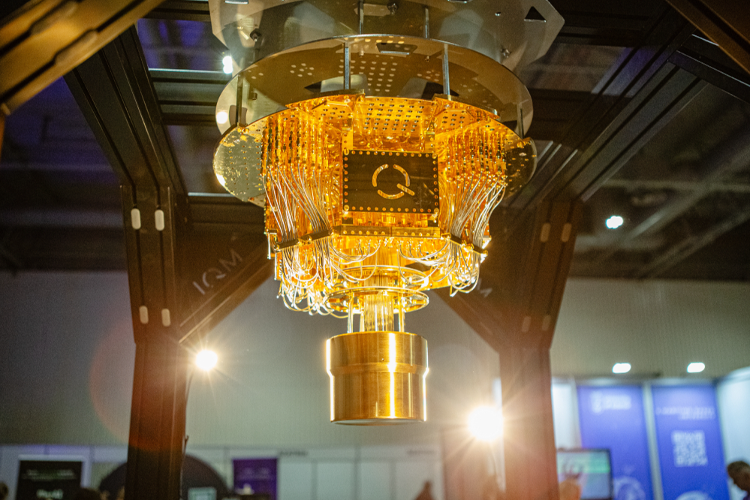
Among the many attractions of Science Hall, the standout was undoubtedly the opportunity to come face to face with a real model of a quantum computer, from IQM Quantum Computers, the only startup in Europe that builds next-generation quantum computers: models – from 5 qubits to 150 qubits – all using superconducting technology. The quantum model from IQM Quantum Computers, although impressive in its shape and appearance, was not the only quantum computer that could be admired by the participants of this year's Summit. The Poznań Supercomputing and Networking Center presented one of two quantum computers of the ORCA Computing PT-1 brand, the design of which is based on quantum photonic systems.
These advanced technologies enclosed in the elegant “cabinet” of the ORCA computer and the spectacular shape of the IQM Quantum Computers model aroused the general admiration and enthusiasm of Summit participants:

“Seeing the quantum computer up close was an awe-inspiring experience. It's incredible to think about the complex calculations and problem-solving capabilities it holds. The potential for advancements in various fields like cryptography and materials science is truly exciting."
"The quantum computer was the highlight of the conference for me. The intricate design and the underlying technology are just fascinating. I was particularly impressed by the detailed explanation given by the experts, which made a complex subject much more understandable".
"The quantum computer was fascinating. The sheer complexity and the cutting-edge research that goes into developing such a machine are impressive. It was a memorable part of the conference."
"The quantum computer display was phenomenal. It's amazing to see how far we've come in technology. This conference has truly been an eye-opener, and I’m looking forward to seeing how quantum computing evolves in the near future."
These reviews from the Evaluation Survey capture the excitement and fascination participants felt when encountering a quantum computer at the Summit.

But beyond the admiration and enthusiasm, it also required Summit participants to familiarize themselves with the basics of quantum mechanics and its application in solving computer problems. Scientists and top experts explained to Summit participants about superposition, entanglement, and quantum interference, among others. Scientists also discussed current and potential applications of quantum applications in various fields such as quantum cryptography, optimization, machine learning, chemistry, medicine, etc. They also talked about the future of quantum computers and their impact on society, the environment, medicine, and technology.
Bianka Siwińska, CEO of the Perspektywy Educational Foundation, who has been appointed by Deputy Prime Minister and Minister of Digital Affairs Krzysztof Gawkowski to the Digitalization Council, as well as the Head of the Team for Quantum Technologies of the Digitization Council, where she will cooperate with leading experts from NASK, IBM, Quantum AI, and Digital Poland, emphasized that:
“Quantum Computing is a field that is particularly attractive to women. In its current form, it is new and created from scratch – so everyone can, without adapting to traditional structures and ways of thinking, co-create them, acquire competencies and develop them. Women work best in such areas because they do not have to break through the ossified, often patriarchal organizational culture”.

IQM Quantum Computers - the only startup in Europe that builds next-generation quantum computers
At IQM Quantum Computers in Finland, 300 scientists are working on a quantum breakthrough – physicists, computer scientists, and engineers from the best centers in the world. Importantly, they are not only building quantum computers there but also working on their connection with HPC – supercomputers. Such a combo, equipped with AI capabilities, may soon (though not yet) seriously fix our world and ensure longevity!
Currently, IQM Quantum Computers has developed two models of quantum computers: IQM Spark™ and IQM Radiance™.
IQM Spark™ is our 5-qubit superconducting quantum computer, tailored for universities and research labs. With custom learning experiences, IQM Spark™ brings affordable and easy access to quantum computing for future scientists, developers, and innovators.
IQM Radiance™ is a 20-qubit system with 20 computational transmon qubits and 30 tunable couplers. This system can be upgraded into a 54-qubit system with 54 computational transmon qubits and 90 tunable couplers. The modular architecture allows the customer to upgrade the system to a 150-qubit system with 150 computational transmon qubits and an additional 266 qubits used as tunable couplers.
In March 2024, IQM also launched IQM Resonance, a quantum cloud service that provides access to quantum machines and systems, allowing programmers and scientists to plan, develop, test, and compare quantum algorithms.
The quantum model from IQM Quantum Computers, although impressive in its shape and appearance, was not the only quantum computer that could be admired by the participants of this year's Summit.
ORCA PT-1 from the Poznań Supercomputing and Networking Center (PSNC)
The Poznań Supercomputing and Networking Center (PSNC) presented one of two quantum computers of the ORCA Computing PT-1 brand, the design of which is based on quantum photonic systems.

The ORCA PT computer is based on bosonic sampling using photons with a wavelength from the telecommunications band. The calculation results obtained in this way constitute very complex statistics, which can be used in applications used for machine learning and optimization. This system can be easily integrated with classical solutions of high-performance computers and equipped with solutions from the Python environment for software development (Software Development Kit). This kit supports hybrid-classical/quantum algorithms, designed to work with graphics and quantum processors.
The technology used in the ORCA computer uses single photons (single "particles" of light) as the information carrier. Thanks to this, the system can easily interact with network technologies, and its structure becomes modular, "flexible", and easy to update. The use of proprietary multiplexing technology by this computer to adjust time, and frequency parameters, and control the path of single photons allows for huge data condensation, and therefore, the realization of full-scale quantum data processing using much fewer components.
The Poznań Supercomputing and Networking Center is known worldwide for its computer infrastructure, which is used in scientific, information, and communication technologies. ORCA Computing’s PT-1 quantum system has been integrated with the existing high-performance computer infrastructure to support and develop key scientific research and innovation in the industry.
By showcasing quantum computing at Summit, we wanted to not only showcase the latest technological advancements of our era, but also inspire students and young women experts to explore and pursue STEM careers, ultimately contributing to a more diverse and innovative future in technology.