
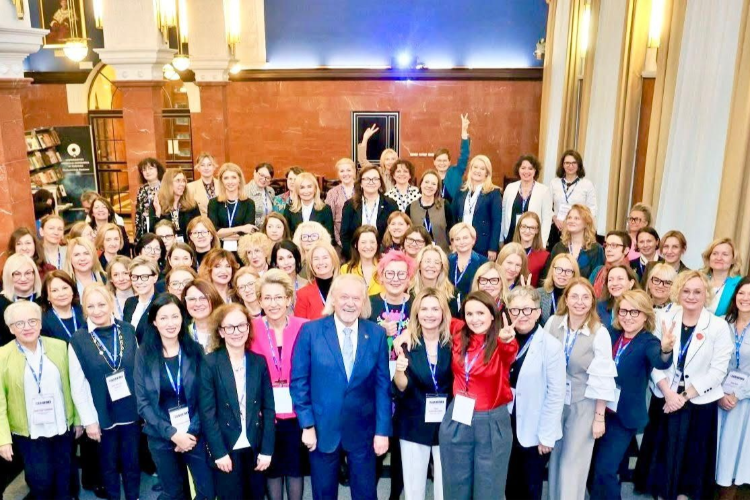
On 14 November 2025, at the Collegium Maximum of the Nicolaus Copernicus University in Toruń, happened a thing with no precedent in the Polish higher education! over 100 women – rectors, vice-rectors, and women heading scientific institutions – met at the first Meeting of Women Rectors. They came from all over Poland – from general, technical, medical, artistic, and vocational universities – in order to talk about modern leadership, cooperation between universities, and the challenges that bind various academic environments.
The initiators and organisers of this meeting were the leaders of the scientific world and higher education:
-
Dr Hab. Magdalena Barwiołek, Vice-Rector of the Nicolaus Copernicus University in Toruń
-
Dr Anna Budzanowska, ex Deputy Minister of Science
-
Prof. Dr Hab. Barbara Jankowska, Rector of the Poznań University of Economics and Business
-
Dr Hab. Anna Jurkowska-Zeidler, Vice-Rector is the University of Gdańsk
-
Prof. Dr Hab. Bogumiła Kaniewska, Rector of the Adam Mickiewicz University in Poznań
-
Dr Bianka Siwińska, Chair of the Perspektywy Education Foundation
-
Prof. Dr Hab. Lucyna Woźniak, Vice-Rector of the Medical University of Łódź
-
Dr Hab. Eng. Danuta Zawadzka, Rector of the Koszalin University of Technology
In the hospitable Nicolaus Copernicus University they were welcomed by its Rector, Prof. Dr Hab. Andrzej Tretyn, who emphasised at the opening press conference: “I am very glad that the UMK Rector’s Council has such a balanced composition. Women Vice-Rectors demonstrate constantly that they have a lot to say and they present a lot of valuable ideas.” This is a clear signal that UMK consciously chooses diversity, dialogue, and full participation of women in management.
On of these ideas was undoubtedly the idea of integrating the environment of female academic leaders in the spirit of sisterhood, mutual support, and dialogue. Dr Hab. Magdalena Barwiołek emphasised that the goal of the event is widely defined cooperation: “The attendance demonstrated that we need such a space! What we are doing is not intended against someone or something. We want to create a solid foundation for cooperation, to inspire each other to new projects, to support each other, and to solve problems – although we come from so many different universities from all over the country, the challenges we face are very similar. We do not lack energy, so it would be a pity to waste it!”
Dr Bianka Siwinska, Chair of the Perspektywy Education Foundation, noted: “Many pioneers met here – women who were the first to do something. Such energy always brings changes.” And so it is! The meeting collected an imposing group of pioneers – the first rectors and vice-rectors in the history of their universities, as well as first women in managerial positions in areas that so far belonged fully to men: the navy, anatomical morphology, hydrography, genetics, or IT.
600 years of waiting for a place at the table
Why is it so exceptional? Let’s not forget that the history of Polish higher education is mostly a history of men. For over 600 years, they were the ones entrusted not just with all the rector duties, but also with the possibility to study at all. The change only came in early 1900s, when the universities started to admit women as students. The following decades saw more changes, but the report “Feminisation of Higher Education in Poland in 1918–2018” shows that although women did study and work in science more often, their presence at the higher managerial positions was extremely limited until the later decades of the 20th century. Only in 1980s the first crack appeared in this monolith: in 1981–1987 the position of the Rector of the Warsaw University of Life Sciences was taken by Prof. Maria Joanna Radomska – the first woman to head a public university in Poland. This fact demonstrates the scale of the historic shift quite well: for centuries the academia was a structure created by men for men, and the rector’s figure was almost inseparably tied to the male identity, authority, and patriarchal model of management.
The change regarding women in the highest positions at the Polish universities really started after 1989. The system transformation, along with European integration of higher education created conditions in which women were able to achieve higher academic levels, run for university governing bodies, and be visible as leaders. According to available data, in 1990–2019 at public universities there was just one woman rector in 45 terms of office! Research shows that only the period after democratic, as well as systemic and social transformation in 1989 became the moment in which the conditions started undergoing radical changes, although the speed of women achieving the highest posts at universities was (and remains) slow.
Systemic changes and new models of leadership
In early 2000s women were already the majority of undergraduate, graduate, and PhD students, as well as an increasing part of the research staff. This created a “talent pool,” without which women’s entry to the highest positions would not be possible. Only Poland’s access to the EU in 2004 and participation in such programmes as Erasmus, Horizon, ERA, EIGE or EWORA introduced new norms for diversity in management. In fact, the last new decades brought research and discussion demonstrating that the traditional model of a rector as a “tough, masculine leader” is not the only one possible. Meanwhile women started offering other styles of leadership: based on dialogue, cooperation, long-term thinking, and mental fortitude. As emphasised by the co-organiser of the Toruń meeting, Prof. Dr Hab. Magdalena Barwiołek, the goal of modern leaders is not competing with men for power over higher education, but building a modern, inclusive management model in which cooperation, diversity of perspective, and mutual support are they key.
The idea mentioned by Dr Hab. Barwiołek perfectly matches the European directions of higher education development. In the entire EU, leadership based on cooperation, balance, and transparency is becoming a standard, not a demand. This is the premise on which EWORA (European Women Rectors Association) – an organisation joining women rectors and vice-rectors from all over Europe – is based. EWORA has emphasised for years that diverse managerial teams react better to crises, adapt to changes quicker, and are more effective in innovating. Meanwhile, the European University Association (EUA) points out that universities that implement Gender Equality Plans, HR Excellence in Research, and inclusive management policies achieve higher levels of institutional stability, better work culture, and stronger competitive positions in international rankings.
Cooperation above rivalry
Prof. Dr Hab. Lucyna Woźniak, Vice-Rector of the Medical University of Łódź and member of the Board of the European Women Rectors Association (EWORA), sayd: “Management based on empathy and dialogue is not a trend – it is academia’s future!”. In this context, the Toruń Meeting is not an “aspirational” event but inclusion of the Polish universities in the mainstream of European standards, where leadership does not mean domination but responsibility of the academic community.
And although management of universities is currently a joint effort of women and men, this time it was women who gave the initiative for creation of a new space for cooperation and exchange of experiences. This is why the voice of Dr Anna Budzanowska, former Deputy Minister of Science, resonated particularly strongly at the Meeting: “Academia’s strongest power are people. And cooperation between women leaders of various universities may actually change the system from within.” This sentence became one of the main mottos of the Toruń meeting, demonstrating that women’s power in academia is not the result of rivalry but the ability to bring together environments, opening dialogues, and initiating new qualities in management. This was also the subject emphasised by Prof. Dr Hab. Barbara Jankowska, Rector of the Poznań University of Economics and Business n her speech: “Female leadership is not an alternative! It is a natural part of the academic environment. This is why it is so important for us to stay in touch and support each other with our experience.”
The fact that the Toruń meeting was most of all a space for female strength, courage, and mutual support resonated also in the words of other speakers. Dr Hab. Eng. Danuta Zawadzka, rector of the Koszalin University of Technology, who has been promoting women’s visibility in technical sciences for years, said: “We are here in order to support each other, to demonstrate together that women really can conquer the world by building their ‘success story’ – each of us separately and all of us together. We are here for our voice to be heard!”. Dr Hab. Anna Jurkowska-Zeidler, Vice-Rector is the University of Gdańsk, emphasised: “The changes taking place at universities require leadership based on cooperation, empathy, and dialogue. If we want the Polish science to be internationally competitive, we must strengthen diverse leader competencies. The presence of women in leadership is not an addition, but a condition for development of strong, open, and modern universities.”
Next step: a countrywide platform for cooperation
The common direction was also visible in the subjects that appeared throughout the Meeting. The discussion included the themes of sisterhood, courage, new managerial culture, but also some very specific, practical issues: the “glass ceiling”, structural discrimination, inclusive language, statistics on representation, and most of all the need for actual cooperation between universities facing similar challenges, regardless of their profile or size. It is therefore clear that female Polish academic leaders do not want to only talk about “problems,” but prefer to jointly design solutions instead.
It is precisely that readiness for joint activity that also resonated in talks about the future of the Meeting. It is becoming more and more clear that the Toruń meeting was not a one-off event but a start of something bigger. Polish female rectors and vice-rectors are already planning to create their own association, which would become a formal platform for cooperation, exchange of experiences, and joint activity supporting quality of higher education. This idea appeared multiple times during discussion, as a natural answer to increasing presence of women among rectors and the need of permanent, structural support for female academic leaders. Such an association would enable real influence on the direction of the Polish higher education, creation of s support network among universities, transparent exchange of good practice, joint activities towards equality and modern managerial culture, as well as organising regular meetings in various academic centres all over the country.
Europe: only one university in four is headed by a woman. What about Poland?
According to the She Figures 2024 report (European Commission,) women make up, on the average, 26% of HEI and research heads in the European Union, i.e., one university rector or president in 4 [European Commission, 2024, She Figures 2024: Gender in Research and Innovation]. In the Nordic countries the indicators exceed 35–40%, while in the countries of Central and Eastern Europe, including Poland, they usually oscillate around 20%.
The data from the European University Association (EUA) shows that participation of women among university rectors increased by 73% in the last eight years, but in 2022 it still did not exceed 20% in member organisations [EUA, 2022, Gender Equality in Higher Education Leadership]. So the trend is upward, but not even: in places with mentoring networks, equality policies, and common practices, women become rectors faster. In Central Europe, the process is only starting to gather up speed.
Meanwhile in the 2024–2028 term there are 22 women leading public universities in Poland, including 12 women rectors of academic universities, and 10 rectors of vocational universities. Among universities belonging to the Conference of Rectors of Polish Universities (KRUP) there are only two women rectors: Prof. Bogumiła Kaniewska (UAM) and Prof. Beata Wojciechowska (UJK) and 39 vice-rectors. According to the data from the Poliss Economic Institute (PIE, 2024), women head about 24% HEIs in Poland: including 17% of public and 30% of private universities. This is better than a decade ago, but still way below the gold standard. In this situation the Meeting in Toruń gains extra meaning, as it was the first time that all the women who co-create the Polish academic leadership met in one place in order to think about how to change the system from within.
2026: meetings in Warsaw and Poznań
The planned creation of an association connected organically with another important topic: further Meetings in various academic cities. At the Toruń meeting Dr Bianka Siwińska made an official invitation to Warsaw, to the meeting of women rectors and vice-rectors during the Perspektywy Women in Tech Summit 2026, the biggest European event for women in technology and science, organised by the Perspektywy Education Foundation. The Summit – a place where women leaders from all over Europe have been meeting for years – will thus become a new “bridge” between academic, technological, and business environments. This is the ideal moment to scale up the Toruń energy.
For autumn 2026 the organisers are declaring the fall meeting – this time in Poznań. The invitation to the capital of Greater Poland was made jointly by two rectors who have been building women’s strong presence in the Polish academia for years: Prof. Dr Hab. Bogumiła Kaniewska, Rector of the Adam Mickiewicz University in Poznań, and Prof. Dr Hab. Barbara Jankowska, Rector of the Poznań University of Economics and Business. This is an important symbol: the first Meeting – Toruń, in the meantime a meeting in Warsaw, and the second official meeting – Poznań: three centres with huge importance in the history of Polish science, showing today what modern, partner-like leadership looks like.
And the fact that the women rectors and vice-rectors are planning another meeting so soon and in so large debating space demonstrates that the initiative is not losing momentum – it is just gaining speed!
Why was this Meeting so important? The Toruń meeting showed that women in university management are no longer an exception, but a real force co-creating the Polish academia. For the time female leaders from such varied environments sat down at one table, not just to talk about change, but to plan it together. This is the moment in which diverse leadership stops being an aspiration – it is becoming a new standard in the development of the Polish higher education.