
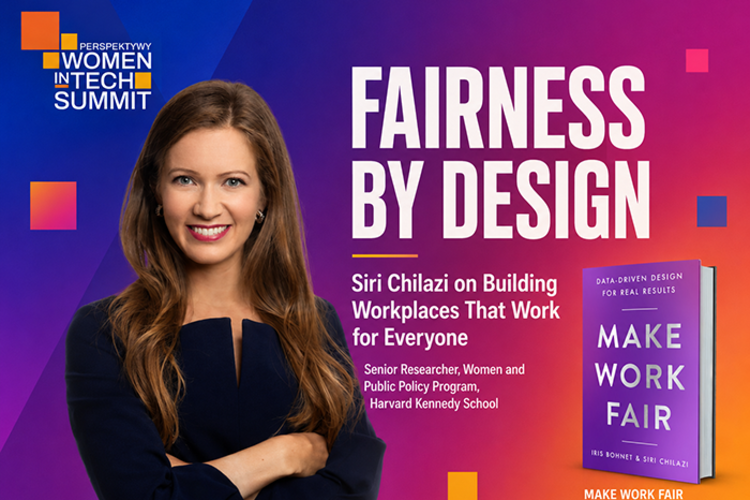
What if fairness at work was not a matter of goodwill, inspirational speeches, or another corporate training module - but a design challenge? This is the question at the heart of Siri Chilazi’s work.
Siri Chilazi is a Senior Researcher at the Women and Public Policy Program at Harvard Kennedy School and one of the most compelling voices in the global conversation on gender equity in the workplace. Her work focuses on a problem that many organizations still struggle to face honestly: even when companies believe in equal opportunity, their everyday systems may continue to produce unequal outcomes. Hiring, promotion, performance evaluation, pay, visibility, leadership pipelines, access to high-impact projects - these are the places where careers are shaped. They are also the places where unfairness can quietly reproduce itself.
At Perspektywy Women in Tech Summit 2026, Siri Chilazi brings a message that is especially relevant for the technology sector: if we want more women to enter, stay, lead, and thrive in STEM, we need to move beyond declarations and redesign the systems that decide who gets opportunity.
From good intentions to measurable results
Chilazi’s academic work is rooted in behavioral science, organizational design, and evidence-based change. Harvard Kennedy School describes her research as focused on identifying practical approaches to closing gender gaps at work by de-biasing structures and designing fairer processes. She also works with organizations ranging from start-ups to Fortune 500 companies, translating research into concrete strategies that can be used in real workplaces.
This distinction matters. In many organizations, diversity, equity, and inclusion have often been treated as separate programs: a workshop, a policy, a statement, an awareness campaign. Chilazi’s work points in a more operational direction. Fairness cannot depend only on whether individual managers happen to be enlightened, careful, or well-intentioned. Fairness has to be embedded into the architecture of work.
Asking different questions.
Who gets invited into the room? Who receives stretch assignments? Who is evaluated on potential, and who has to prove themselves again and again? Whose mistakes are treated as learning moments, and whose mistakes become evidence of lack of fit? Who gets sponsorship, informal information, visibility, and access to decision-makers?
These questions may sound human and cultural, but they are also structural. They are built into processes. And processes can be redesigned.
The book: Make Work Fair
In 2025, Siri Chilazi and Iris Bohnet published Make Work Fair: Data-Driven Design for Real Results, a major book that offers a practical, evidence-based blueprint for building fairer workplaces. The book was published by Harper Business / HarperCollins on January 28, 2025.
The core argument is direct and powerful: believing in equal opportunity is essential, but belief is not enough. Harvard Kennedy School’s description of the book emphasizes that Make Work Fair offers an evidence-based blueprint for making fairness real regardless of a person’s role, seniority, responsibilities, or location.
The book arrives at a crucial moment. Across the world, organizations are under pressure to show that their fairness and inclusion efforts produce real results. At the same time, DEI has become politically contested, particularly in the United States. In this context, Chilazi and Bohnet propose a more rigorous and practical path: focus on fairness, use data, test what works, and change the everyday systems through which people are hired, evaluated, promoted, paid, heard, and trusted.
The Financial Times included Make Work Fair in its 2025 summer business books selection, describing it as a timely, evidence- and research-based analysis of how to move forward amid the culture wars around DEI.
Fairness as workplace infrastructure
One of the most important ideas in Make Work Fair is that unfairness is often built into the environment of work. The Women and Public Policy Program’s 2025 reading list summarizes the book’s argument clearly: many organizations invest time and resources in DEI initiatives, yet these efforts often fall short because unfairness is embedded in workplace structures, processes, and environments. As a result, the burden of fixing inequity is too often shifted onto the very people those initiatives are meant to support.
For years, the conversation about women in tech has focused on confidence, ambition, mentoring, role models, and encouragement. All of these matter. But they are not sufficient if the systems around women continue to leak talent. A woman can be ambitious and highly skilled, yet still be overlooked for the most strategic project. She can be technically excellent, yet receive less sponsorship. She can perform strongly, yet be evaluated through a narrower lens. She can enter the pipeline, yet discover that the higher she goes, the more informal and opaque the rules become.
Chilazi’s work helps name the deeper issue: the problem is often not the absence of talent. The problem is the way talent is recognized, assessed, rewarded, and advanced.
For companies competing for the best minds in AI, cybersecurity, quantum technologies, space, energy, data science, engineering, and digital infrastructure, this is not a side issue. It is a question of whether an organization can see and use the talent it already has.
Systems, not slogans
In a 2025 Harvard Business Review IdeaCast conversation, Iris Bohnet and Siri Chilazi discussed how organizations can increase diversity through systems rather than programs. The episode framed the question bluntly: if DEI programs are not effective, what is?
Their answer is rooted in behavioral design. Instead of relying primarily on training people to become less biased in the abstract, organizations should redesign the moments where bias is most likely to affect outcomes. Those moments include recruitment, shortlisting, interviews, performance reviews, promotion decisions, pay decisions, work allocation, meeting norms, and leadership selection.
The point is not to deny individual responsibility. The point is to recognize that humans make decisions inside systems. If the system is vague, rushed, informal, or built around subjective judgments, bias has more room to operate. If the system is structured, transparent, data-informed, and designed around clear criteria, better decisions become easier.
This is why Chilazi’s work is so valuable for leaders. It translates fairness from a value into a management discipline.
What the research shows
Chilazi’s work is not limited to theory. Her research and writing repeatedly ask a practical question: what interventions actually change outcomes?
In 2025, Science published “Behaviorally designed training leads to more diverse hiring,” a field experiment co-authored by Cansın Arslan, Edward H. Chang, Siri Chilazi, Katryn Wright, Priya Gill, Oliver P. Hauser, and Iris Bohnet. The paper presents a proof of concept that behaviorally designed diversity training can lead to more diverse hiring.
This is significant because much traditional diversity training has been criticized for weak or inconsistent effects. The study points to a more precise model: training can be more effective when it is designed around behavior and delivered close to the moment of decision. In other words, the intervention matters most when it helps a manager make a better decision at the point where that decision actually happens.
A related Harvard Business Review article from October 2025, co-authored by Chilazi and colleagues, describes collaborations with two multinational companies and a simple intervention designed to improve managers’ fairness throughout the hiring process.
This is the kind of evidence-based approach that resonates strongly with the technology sector. Engineers, product leaders, and data-driven organizations understand the logic of iteration: define the problem, intervene, measure, learn, improve. Chilazi applies that same discipline to workplace fairness.
Start with one high-impact behavior
In January 2026, Harvard Business Review published “To Change Company Culture, Start with One High-Impact Behavior,” co-authored by James Elfer, Siri Chilazi, and Edward Chang. The article argues that organizations can influence culture meaningfully by identifying one behavior or decision with high impact, building a data-driven theory of change, embedding the intervention at the relevant decision point, and testing its effect.
This is a sharp corrective to one of the most common mistakes in culture work: trying to change everything at once. Culture can feel enormous, abstract, and impossible to move. Chilazi’s approach makes it more actionable. Choose a behavior. Locate the moment where it happens. Redesign that moment. Measure the result.
For a technology company, that could mean changing how interview panels evaluate candidates. For an engineering organization, it could mean redesigning how high-visibility tasks are distributed. For a scale-up, it could mean introducing clearer promotion criteria before informal networks begin to determine advancement. For a conference, media platform, or expert community, it could mean tracking who gets invited to speak, who is quoted as an expert, and who is repeatedly treated as a thought leader.
Small design changes can have large consequences when they are placed at the right point in the system.
Why this matters for women in tech
The technology sector often presents itself as meritocratic. In theory, the best ideas win, the strongest code matters, and talent rises. In practice, no organization is free from social dynamics. Visibility, networks, confidence, sponsorship, assumptions about leadership, stereotypes about technical credibility, parental status, communication styles, and access to informal knowledge all influence careers.
This is why fairness in tech cannot be reduced to representation statistics. Representation matters, but numbers alone do not tell us whether people have equal access to opportunity once they enter the organization.
Chilazi’s work pushes the conversation deeper. It asks whether the system is designed to let talent emerge fairly.
Are job descriptions written in a way that attracts a broad candidate pool? Are interviews structured? Are performance reviews based on evidence or impressions? Are promotion criteria transparent before people are evaluated against them? Are stretch assignments distributed deliberately or through informal trust networks? Are women expected to perform invisible work for the organization - mentoring, culture-building, emotional labor - without that work being valued in promotion decisions?
These questions are not theoretical. They define who advances. For women in STEM, they can define whether a promising career accelerates or stalls.
Venture capital, innovation, and who gets funded
Chilazi’s work also extends into the venture capital ecosystem. Her Harvard Kennedy School report Advancing Gender Equality in Venture Capital examines the state of gender equality in the U.S. VC industry and offers a practical path forward to close significant gender gaps. The report is designed as a resource for practitioners in the venture ecosystem, as well as journalists, scholars, and others interested in gender dynamics in VC.
This angle is especially important for Women in Tech. Venture capital decides which ideas receive fuel, which founders scale, which technologies reach the market, and who gets to build the future. If funding systems are biased, then innovation itself becomes narrower than it should be.
In other words, fairness is not only an HR issue. It is an innovation issue. It shapes which products are built, whose problems are solved, which companies survive, and who becomes a founder, investor, board member, or category-defining leader.
The new language of fairness
One reason Siri Chilazi’s work feels so timely is that it offers a way out of an increasingly polarized conversation. In a Financial Times interview, Bohnet and Chilazi argued for integrating fairness into everyday work rather than treating DEI as a silo separate from core business activities. The article also notes their concern that organizations should not abandon fairness itself simply because some initiatives have not worked.
This matters because the future of work needs a more mature language. Fairness cannot survive as a decorative value. It has to become part of how organizations make decisions.
For leaders, this means accountability. For managers, it means process discipline. For HR and people teams, it means moving from policy ownership to systems design. For employees, it means understanding that fairness is not only something to request from leadership. It can also be practiced through everyday choices: whose voice is amplified, how meetings are run, how credit is shared, how feedback is given, how opportunities are distributed.
The most powerful part of Chilazi’s approach is that it does not wait for perfect people. It builds better conditions for imperfect people to make fairer decisions.
A Summit voice for the future of work
Siri Chilazi’s presence at Perspektywy Women in Tech Summit 2026 is important because the Summit has always been about more than visibility. It is about access, leadership, opportunity, and systemic change. It is about what happens after a girl chooses STEM, after a woman enters tech, after an engineer joins a team, after a founder starts building, after a leader gets a seat at the table.
The next frontier is not only getting women into technology. It is making sure technology does not waste their talent. That requires fairer systems of hiring, promotion, pay, leadership, capital, recognition, and influence. It requires organizations to examine not only who they say they value, but how their decisions actually work.
Siri Chilazi brings the science, the evidence, and the language to do exactly that. Her message is both practical and demanding: fairness is possible, but it has to be designed. It has to be measured. It has to be embedded into the everyday machinery of work.
And in a world where technology is transforming everything - from energy and healthcare to finance, space, security, education, and work itself - the question of who gets to participate, lead, and benefit from that transformation is one of the most important questions of our time.
At Perspektywy Women in Tech Summit 2026, Siri Chilazi will help us ask that question with precision, courage, and evidence.