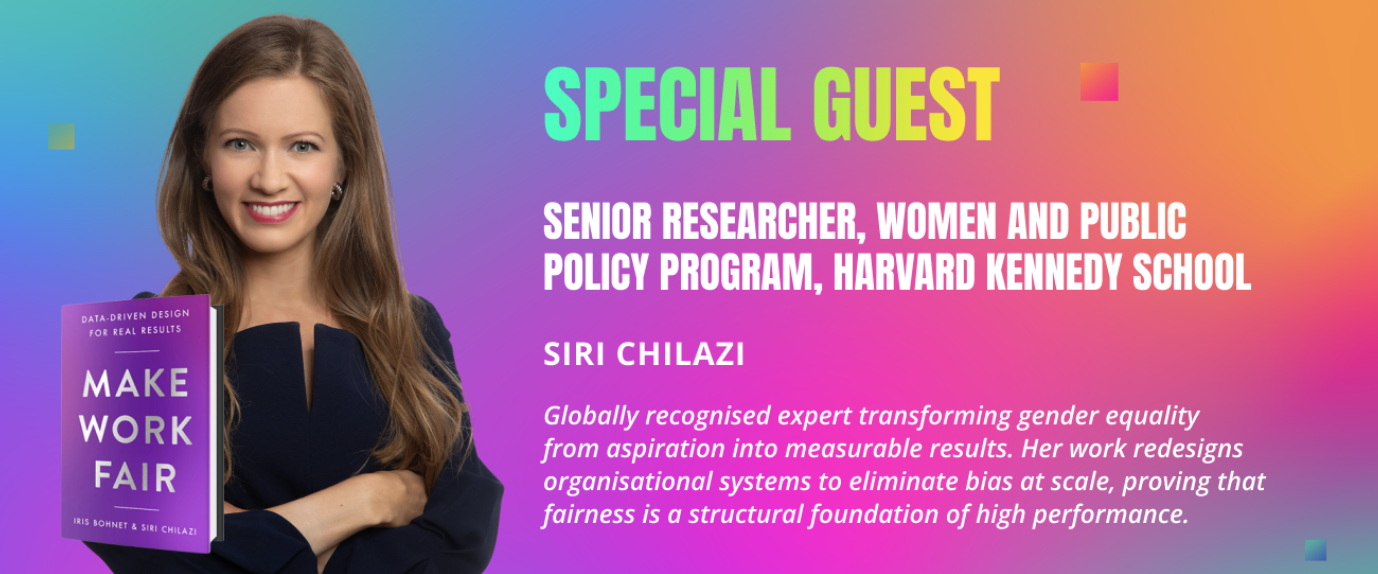
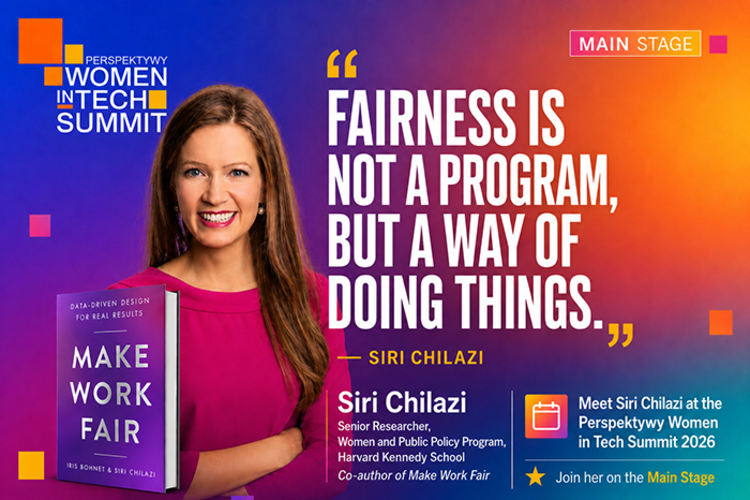
Traditional DEI programmes often promise change, but too rarely transform the everyday systems in which decisions are actually made. Siri Chilazi, Senior Researcher at the Women and Public Policy Program at Harvard Kennedy School and co-author of Make Work Fair, argues that fairness cannot be reduced to annual campaigns, symbolic initiatives or one-off trainings. Real progress begins much closer to daily work: in meetings, hiring processes, promotions, performance reviews and the way organizations structure decision-making.
Ahead of her appearance on the Main Stage at the Perspektywy Women in Tech Summit 2026, the Polish Press Agency spoke with Siri Chilazi about behavioral design, the limits of traditional DEI, the hidden bias built into CVs, the role of artificial intelligence in recruitment, and why truly fair workplaces are not created by good intentions alone - but by smarter systems.
Polish Press Agency: In June, you will be the keynote guest at the Perspektywy Women in Tech Summit 2026. What is the main message you are bringing to the conference?
SIRI CHILAZI: I am a researcher, so all my work is based on evidence, hard data, and the results of scientific analysis. And this scientific evidence clearly shows that the traditional approach to diversity, equity and inclusion — the so-called DEI, Diversity, Equity, Inclusion - simply does not work. For example, organizations create leadership training programmes for women or special recruitment processes for minorities. Once a year, we celebrate Women’s Day or Pride Month. Instead, what we need are actions embedded in everyday work.
Polish Press Agency: What kind of actions, for example?
SIRI CHILAZI: In our everyday work, we sit in meetings, assign people to projects, make decisions about hiring, promotions, performance reviews, pay rises, and bonuses. It is not about creating new committees or events. It is about looking at our calendar and asking: “Since I am already sitting in meetings anyway, how can we run them better, so that we draw on everyone’s knowledge and do not silence some voices?” If I had to summarize my message in one sentence, it would be this: fairness is not a program, but a way of doing things. It is about concrete actions that we are already taking every day at work.
Polish Press Agency: What exactly is behavioral design, which you focus on in your academic work?
SIRI CHILAZI: It is the design of the work environment - conference rooms, recruitment processes, parental leave policies, or flexible working arrangements - with regard to how people actually function. Behavioral design draws on behavioral economics, psychology, neuroscience, and organizational behavior. Knowing that human brains are naturally burdened with biases, we ask ourselves how to create an environment that will nevertheless allow us to make better decisions.
Polish Press Agency: How does such “smart management” help fight bias?
SIRI CHILAZI: As human beings, we have various biases rooted in our brains. Research also shows that it is extremely difficult to eradicate them from individual people. Different interventions, trainings, exercises, and educational approaches have been tested. Dozens of studies conducted over decades prove that these methods do not work when it comes to how our brain processes information and makes decisions.
What truly works is eliminating bias from the processes that surround us. Even a biased brain will make a more objective decision if we provide it with a smart, structured process. In anti-bias efforts, we therefore need to focus less on individuals and more on procedures.
Polish Press Agency: What, then, does research say about running effective business meetings?
SIRI CHILAZI: Research shows that the more often voices are exchanged during meetings - that is, the more people have the opportunity to speak - the higher the quality of the decisions made by the group. Instead of the person leading the meeting throwing out a general question such as: “What do you think about this?”, where the discussion will be dominated by one or two of the loudest people, they can give everyone one minute to present their position.
Another method is this: before the discussion, we ask everyone to write down their opinion on pieces of paper, for example anonymously. We collect them and discuss them.
Polish Press Agency: Let us move on to recruitment. What does research say about eliminating bias at the stage of hiring new employees?
SIRI CHILAZI: The more structure there is in decision-making, the less bias there is. The more informality there is, the more bias appears. In recruitment, this means that before we even start looking, we need to create a very precise job description: what exactly this person will be doing and what skills they need. This is the starting point for creating test assignments. If we are hiring someone for a role that requires a lot of writing, then rather than reviewing a CV or having a loose conversation about everything and nothing, it is much better to leave that person in a room for an hour, ask them to write an article on an assigned topic, and assess the quality of that text. This best predicts how the candidate will perform at work.
A classic example comes from auditions in American symphony orchestras in the 1970s. A rule was introduced there that musicians played behind a curtain. The directors heard the music and assessed its quality, but they were not distracted by what they saw. The only thing that mattered was how the musicians played.
Polish Press Agency: And could you tell us about the study concerning gaps in CVs?
SIRI CHILAZI: My colleagues conducted a study in the United Kingdom covering job offers from more than 9,000 employers across eight sectors. We know that people sometimes have gaps in their CVs - breaks taken to raise children or care for an elderly parent. Companies often discriminate against such people. A small change in the format of the CV was tested. The traditional chronological CV layout includes dates, which immediately reveals every break from work. Meanwhile, the researchers removed the dates and left only the duration of each experience. They wrote: “consultant: 3 years, senior consultant: 7 years, manager: 10 years.” The result? In recruitment practice, companies matched talent to their needs more effectively, because they stopped pointlessly rejecting excellent candidates only because of employment breaks.
Polish Press Agency: Artificial intelligence is becoming increasingly present in the market. Can AI help fight bias in the labor market, or quite the opposite?
SIRI CHILAZI: AI is a tool. The great promise of artificial intelligence is that it is easier to remove bias from a model than to change millions of individual human minds. On the other hand, current AI models are a black box. Research shows that when women and men ask AI for advice on salary negotiations, they receive different answers. AI advises men to take an aggressive stance and demand a higher salary. It suggests to women that they should not negotiate pay, but ask for more vacation days instead. In this way, AI reinforces biases from the real world.
Polish Press Agency: And does it make sense to use AI to analyze the CVs of candidates for a given position if we want to avoid bias?
SIRI CHILAZI: For decades, we told companies: “Stop using CVs,” but they did not listen to us. Now this is changing because of AI. Anyone can go to ChatGPT and generate a perfectly polished CV in three seconds. Companies are finally realizing that the predictive value of a traditional résumé is close to zero. And this is a positive effect - it forces organizations to focus on candidates’ real skills and on work-sample tests. We cannot simply add AI to old, flawed habits. We need to reframe the entire process. We have to maintain structure until the very end. It often happens that we have ten candidates, decision-makers enter the room, and someone says: “I just liked this guy, I think he’ll be great, let’s hire him.” At that point, all the earlier data-gathering about skills becomes pointless. We must constantly refer back to the criteria agreed in advance and rank the candidates. If we want to bypass that ranking, we must have a very serious reason for doing so.
Polish Press Agency: What, then, is the first, fastest step we need to take as a society?
SIRI CHILAZI: Each of us must realize that creating a fair workplace is our task. My advice is this: look at what you are already doing every day and change one small thing. The next time you go to a work meeting, say: “Today, I would like to hear the opinion of every person sitting at this table.” Together with my colleague Iris Bohnet, I wrote a book last year titled Make Work Fair. It contains a roadmap with exactly these kinds of small adjustments, which cost nothing, require no extra time, and radically improve processes immediately. If you are in a senior position, you can drive bigger changes. But even if you are at the very bottom of the hierarchy, you can take this small step. If we all took such a step, the world would change in an instant.