The Sci/Eng Stage Guide: Big Science, Deep Tech, Quantum, Biotech, Nuclear and the Future of Engineering
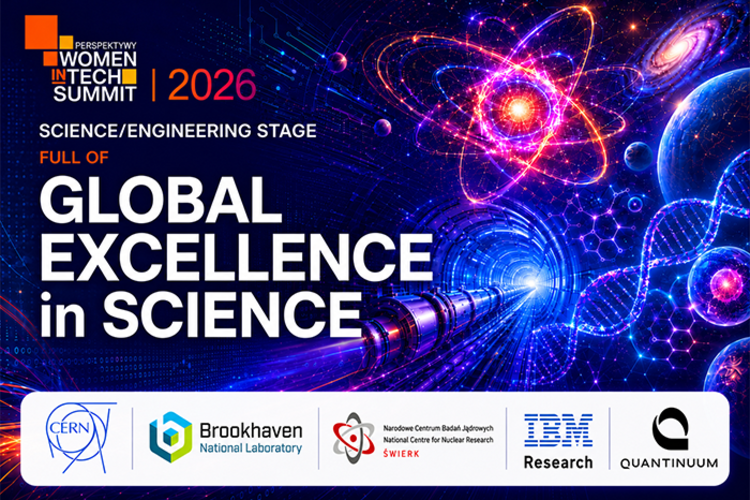
The Sci/Eng Stage at Perspektywy Women in Tech Summit 2026 is where science stops being distant and becomes tangible: a force shaping medicine, energy, security, space exploration, aviation, materials, mental health, quantum technologies and the future of human capability.
Across two days, this stage brings together researchers, engineers, physicists, technologists, founders, educators, policy thinkers and science communicators from leading institutions and companies including CERN, IBM Research, Brookhaven National Laboratory / C2QA, ICFO, GE Aerospace, the German Aerospace Center, GESDA, NCBJ, Steady Energy, Amentum, SoftServe, SWPS University, Warsaw University of Technology, AGH University of Science and Technology, the University of Gdańsk, Creotech Quantum, Holcim, Trend Glass and many more.
This is the stage for everyone who wants to see where technology really begins: in laboratories, research teams, experimental infrastructure, engineering challenges, living systems, clean energy projects, quantum breakthroughs and the people brave enough to translate complexity into impact.
The Sci/Eng Stage is not only about listening to science. It is about entering the systems that will define the next decade: quantum computing, nuclear energy, biotech translation, space medicine, digital diagnostics, advanced materials, sustainable aviation, cybersecurity, science communication and deep-tech careers.
Why this stage matters
The Sci/Eng Stage gives Summit participants a rare route through the full landscape of future-facing science and engineering.
It shows how biomaterials can change regenerative medicine, how digital phenotyping can make diagnostics more continuous and human-centred, how quantum computing is becoming a global power play, how nuclear energy moves from research to real deployment, how CERN-style big science depends on thousands of experts beyond physics, how advanced materials shape everyday life, and how space exploration forces us to rethink the limits of the human body.
The central message is clear: tomorrow’s technologies will not be built by one discipline alone. They will be built by people who can cross boundaries between science, engineering, policy, education, communication, business, ethics and society.
10 June — Sci/Eng Stage
Engineering the Future of Medicine: Novel Biomaterials Tissue Regeneration
Date: 10 June 2026
Time: 09:00–09:10
Place: Sci/Eng Stage
Speaker: Dagmara Słota, Assistant, Cracow University of Technology
Track / theme: Biotech, biomaterials, regenerative medicine
This talk opens the Sci/Eng Stage with a look at the future of personalised medicine and regenerative therapies. Dagmara Słota will present recent advances in multifunctional biomaterials and their potential use in bone and osteochondral tissue regeneration.
The session will cover bioactive bone cements, multifunctional implant coatings, advanced materials for bone and cartilage defect replacement, and the role of nanotechnology in modern medicine. It will also explore whether gold nanoparticles can help track the distribution of anticancer drugs in the body and support more precise targeted therapies.
At its core, this is a talk about the intersection of materials engineering, biotechnology and medicine — and about how interdisciplinary science can create next-generation, patient-specific treatment strategies.
If Everyone Has AI, What Becomes Your Advantage? — Why the Most Important Tech Skill May No Longer Be Only Technical
Date: 10 June 2026
Time: 09:15–09:25
Place: Sci/Eng Stage
Speaker: Karol Jędrasiak, PhD Eng., Deputy Director of the Technology Transfer Centre, WSB University
Track / theme: AI, professional advantage, future skills
AI can now write, code, analyse data, create presentations and support decision-making. This talk asks a sharp question: if almost everyone has access to these tools, where does real professional advantage come from?
Karol Jędrasiak will explore why the most important tech skill may no longer be only technical expertise. Increasingly, advantage may depend on asking the right questions, critically evaluating AI outputs, understanding context and knowing how technology is supposed to create value.
This session is especially relevant for people who want to build durable skills in a world where AI becomes part of everyday work, but human judgment, responsibility and the ability to connect different perspectives become more valuable than ever.
Where Can Humans Go Next? Testing the Limits of Human Endurance in Extreme Environments
Date: 10 June 2026
Time: 09:35–10:15
Place: Sci/Eng Stage
Format: Discussion panel
Speakers:
Aleksandra Rutczyńska, Senior Software Engineer, Artemis Mission, German Aerospace Center
Agata Harasymczuk, Assistant Professor at the Faculty of Space Technologies, AGH University of Science and Technology
Agata Mintus, Chief Operations Officer and Science Lead, LunAres
Izabela Świca, Member of the Board, Polish Astrobiology Society
Moderator: Weronika Boguś, Co-founder, AstroYouth
Track / theme: Space, human endurance, extreme environments, space-biotech
How far can the human body go — and what must we understand before sending people farther than ever before?
This panel brings together perspectives from physiology, extreme environments and emerging space-biotech thinking. The speakers will examine how the brain and body respond to isolation, pressure, radiation, oxygen deprivation and other conditions that define both deep spaceflight and life at the edges of Earth.
The discussion connects endurance, adaptation and survival with the future of exploration. It also opens the door to the young researchers and interdisciplinary thinkers shaping what comes next in space science and human performance.
Future of Flight – Next Engineers
Date: 10 June 2026
Time: 10:25–10:50
Place: Sci/Eng Stage
Speakers: Anna Fornalczyk, Systems Subsection Manager, GE Aerospace; Agata Wiśniewska, Staff Engineer, GE Aerospace
Track / theme: Aerospace, engineering education, future talent
GE Aerospace will present the Next Engineers programme and its impact on young students. The session will show how the four-year initiative strengthens the connection between schools and business, encourages students to pursue technical education, supports skills development and helps build a pipeline of future engineering talent.
The panel will also connect the programme to the future of flight, including next-generation engine applications such as Open Fan architecture, hybrid-electric propulsion and 100% Sustainable Aviation Fuels.
This is a strong session for anyone interested in engineering education, aerospace innovation and how industry can actively build the next generation of technical talent.
GRAND OPENING – LIVE TRANSMISSION
Date: 10 June 2026
Time: 11:00–11:45
Place: Sci/Eng Stage
Speaker: Bianka Siwińska, President, Perspektywy Education Foundation
Format: Live transmission
Track / theme: Summit opening
The Sci/Eng Stage will host a live transmission of the Grand Opening of Perspektywy Women in Tech Summit 2026.
This moment sets the tone for the entire Summit and connects the Sci/Eng audience with the broader opening message of the event.
404: Stereotypes Not Found — Ministry of Digitisation
Date: 10 June 2026
Time: 11:50–12:30
Place: Sci/Eng Stage
Format: Discussion panel
Speakers / moderator: Not specified in the visible agenda entry
Track / theme: Stereotypes, digital transformation, inclusion
This discussion panel is listed in the official Sci/Eng Stage agenda under the title “404: Stereotypes Not Found (Ministry of Digitisation).”
The visible agenda entry provides the title, time, place and format, but no extended event description or speaker list is available on the event listing.
Quantum Stage Opening
Date: 10 June 2026
Time: 12:35–12:50
Place: Sci/Eng Stage
Speakers: Cierra Lunde, CEO & Co-Founder, Universum Labs; Diya Nair, Head of Outreach, Girls in Quantum; Bianka Siwińska, President, Perspektywy Education Foundation; Anna Topol, CEO, Qlithic
Track / theme: Quantum, science, interdisciplinary innovation
The Quantum Stage Opening launches one of the strongest thematic arcs of the Sci/Eng programme: quantum as science, technology, education, career path and cultural shift.
This opening brings together leaders working across quantum, outreach, research communication and technology. It frames the quantum part of the Summit as an interdisciplinary space where computing, education, community-building, communication and future careers meet.
The Future of Science: What Breakthroughs Should We Prepare For Now?
Date: 10 June 2026
Time: 12:55–13:10
Place: Sci/Eng Stage
Speaker: Martin Müller, Executive Director of Science Anticipation, GESDA
Track / theme: Science anticipation, breakthrough technologies, future readiness
This talk asks what scientific breakthroughs we should prepare for before they fully arrive.
Martin Müller will bring the perspective of science anticipation: identifying emerging scientific and technological shifts early enough to understand their possible impact, opportunities, governance challenges and societal implications.
The session is especially valuable as a bridge between research and strategic thinking: it treats science not only as discovery, but also as something that requires readiness, responsibility and long-term imagination.
Quantum Computing: From Fundamentals to Future Impact
Date: 10 June 2026
Time: 13:15–13:30
Place: Sci/Eng Stage
Speaker: Heike Riel, IBM Research, IBM
Track / theme: Quantum computing, deep tech, future computing
Heike Riel from IBM Research will introduce quantum computing from fundamentals to future impact.
The talk will connect the underlying scientific principles of quantum computing with the technological work needed to build scalable systems. It is an essential session for participants who want to understand why quantum computing matters, what makes it different from classical computing and how it could reshape future computational capabilities.
This is one of the core quantum sessions of the Sci/Eng Stage.
Shaping the Quantum Future: Geopolitics, Education, and Transformation
Date: 10 June 2026
Time: 13:35–14:15
Place: Sci/Eng Stage
Format: Discussion panel
Speakers: Nydia Assaf Aragón, Founder & CEO, EnLuz; Cierra Lunde, CEO & Co-Founder, Universum Labs; Denise Ruffner, President, DiviQ
Moderator: Kiran Kaur Raina, Founder & CEO, NucleQi
Track / theme: Quantum tech, geopolitics, education, skills, transformation
Quantum computing is no longer only a scientific pursuit. It is becoming a global power play.
This panel explores whether the quantum race mirrors past technological rivalries or represents something new. The speakers will discuss what quantum competition means for countries, startups and international collaboration in a rapidly shifting landscape.
The panel also addresses one of the biggest blockers of quantum progress: the skill gap. It asks how we teach quantum, who gets to participate, what skills matter now, what risks are being underestimated and what the next decade could bring as quantum moves from promise to power.
Girls in Quantum
Date: 10 June 2026
Time: 14:20–14:35
Place: Sci/Eng Stage
Speaker: Diya Nair, Head of Outreach, Girls in Quantum
Track / theme: Quantum, outreach, young talent, women in science
This session speaks directly to students and early-career attendees who are curious about quantum but unsure where to begin.
Diya Nair will show that entry points into quantum can come not only through formal technical training, but also through community, mentorship, outreach, communication and global collaboration.
The key message is powerful: building the future quantum workforce starts with making sure more young women can see themselves in it.
Quantum Reality: Why Security and Education Decide Everything
Date: 10 June 2026
Time: 14:40–14:55
Place: Sci/Eng Stage
Speaker: Kiran Kaur Raina, Founder & CEO, NucleQi
Track / theme: Quantum tech, post-quantum security, education, workforce
Quantum computers will challenge today’s cryptographic systems, which makes secure and timely adoption of post-quantum solutions essential to protect data, infrastructure and trust.
Kiran Kaur Raina will argue that quantum technology’s success depends on two critical factors: security and education. Without a well-prepared workforce and robust security frameworks, quantum innovation cannot scale or be trusted.
This session frames quantum not only as a technological breakthrough, but also as an urgent education and security challenge.
Hear from the Chief Information Officer at CERN
Date: 10 June 2026
Time: 15:00–15:15
Place: Sci/Eng Stage
Speaker: Enrica Porcari, Chief Information Officer, CERN
Track / theme: Deep tech, big science, computing, CERN, large-scale research infrastructure
Enrica Porcari will discuss key technical challenges currently faced by CERN, including the development of the High-Luminosity LHC and the Future Circular Collider.
These projects require advanced engineering, computing solutions and collaboration between experts from many scientific fields. The session will show how large-scale scientific research depends on interdisciplinary cooperation between thousands of scientists, engineers and researchers working across countries and institutions.
The talk will also highlight technological spin-offs emerging from CERN’s research environment, including developments related to AI, quantum computing and other technologies created alongside big science projects.
Making Science Memorable – Hear from the CERN FameLab Winner
Date: 10 June 2026
Time: 15:20–15:35
Place: Sci/Eng Stage
Speaker: Natalia Izdebska, PhD candidate, Warsaw University of Technology
Track / theme: Science communication, CERN, public engagement
This session focuses on the art of making science memorable.
Natalia Izdebska, CERN FameLab winner, will show how complex scientific ideas can be communicated in ways that are vivid, clear and engaging. The session is especially important in a programme full of deep tech and advanced science, because the future of science depends not only on discovery, but also on the ability to explain why discovery matters.
This is a strong talk for researchers, educators, communicators and anyone who wants science to reach wider audiences.
You Don’t Have to Be a Physicist to Shape the Future of Science
Date: 10 June 2026
Time: 15:40–15:55
Place: Sci/Eng Stage
Speaker: Maria Alandes Pradillo, Computer Engineer, CERN
Track / theme: CERN, scientific careers, IT, software, infrastructure, engineering
This talk delivers one of the most important career messages of the Sci/Eng Stage: you do not have to be a physicist to shape the future of science.
Maria Alandes Pradillo will show how CERN’s work depends on many kinds of expertise beyond physics, including computer engineering, software, infrastructure, data and IT. The session reframes big science as a vast ecosystem of roles and skills.
It is especially relevant for participants who are interested in science but do not see themselves in a traditional research path. CERN-level science needs physicists, but it also needs engineers, developers, infrastructure experts and people who can build the systems that make discovery possible.
The Quantum Edge: Innovation, Defence, and a Career at the Frontier
Date: 10 June 2026
Time: 16:00–16:15
Place: Sci/Eng Stage
Speaker: Lucy Maidwell, Quantum Computing Lead, MBDA UK
Track / theme: Quantum, defence, innovation, careers
This session brings quantum into the context of defence, innovation and careers at the technological frontier.
Lucy Maidwell will explore how quantum technologies may influence strategic sectors and what it means to build a career in a field where science, security and innovation intersect.
The talk is particularly relevant for participants interested in quantum beyond the laboratory: as a technology with implications for national security, industry and future engineering careers.
Building a Racecar – From Start to Finish
Date: 10 June 2026
Time: 16:20–16:30
Place: Sci/Eng Stage
Speaker: Joanna Popielewska, President & CFO, PWR Racing Team, Wrocław University of Science and Technology
Track / theme: Engineering, Formula Student, systems thinking, product development
This talk takes participants inside the process of building a racecar from concept to finished machine.
Joanna Popielewska will present the engineering, organisational and analytical work behind Formula Student. The session connects CAD, risk mitigation, trade-off analysis, logistics, product lifecycle thinking and data analytics.
It is a compact but highly practical engineering story: how a student team turns complex requirements into a working, competitive vehicle.
Cell Culture Monitoring, Engineering Living Systems
Date: 10 June 2026
Time: 16:35–16:45
Place: Sci/Eng Stage
Speaker: Monika Janik, Assistant Professor, Warsaw University of Technology
Track / theme: Bioengineering, diagnostics, sensors, living systems
This session explores bioengineering through the lens of cell culture monitoring.
Monika Janik will show how living systems can be measured and understood using sensors, diagnostics and real-time monitoring. The talk connects engineering with biology and medicine, showing how precise observation of cell cultures can support better research, diagnostics and biomedical innovation.
It is a clear example of how engineering tools are increasingly being applied to living systems.
CARLA Capsule: Professional Opportunities Enabled by Quantum
Date: 10 June 2026
Time: 16:50–17:30
Place: Sci/Eng Stage
Format: Discussion panel
Speakers: Verònica Ahufinger, Head of Academic Affairs, ICFO; Dobrosława Bartoszek-Bober, Research Project Manager & Physicist, Nicolaus Copernicus University in Toruń; Morgan Mitchell, ICREA Professor of Quantum Optics, ICFO; Aleksandra Sierant, Research Fellow, ICFO
Moderator: Lydia Sanmartí-Vila, Head of Outreach, ICFO
Track / theme: Quantum careers, photonics, deep tech, professional pathways
This panel focuses on professional opportunities enabled by quantum technologies.
The speakers will discuss career paths connected with quantum, photonics and deep tech, showing how different roles and profiles can contribute to a fast-growing field. It is a practical complement to the more technical and strategic quantum sessions earlier in the day.
For students, researchers and professionals considering where quantum could take them, this session offers a concrete look at possible routes into the field.
Quantum Fractals: Landscapes of the Unseen Where Quantum States Become Form
Date: 10 June 2026
Time: 17:35–17:45
Place: Sci/Eng Stage
Speaker: Wiktor Mazin, Quantum Fractal Artist
Track / theme: Quantum art, science communication, inspiration
Wiktor Mazin bridges quantum computing and fractal geometry, turning quantum states, gates and circuits into visually striking forms.
A Quantum Fractal Artist and Qiskit Advocate with an engineering background, he uses art to make quantum computing more inspiring and accessible to broader audiences. His work connects chaos theory, Turing patterns, quantum states, visual culture and science communication.
This is a closing session for Day 1 that expands the meaning of science communication: quantum is not only something to calculate, but also something to imagine, visualise and feel.
11 June — Sci/Eng Stage
Multimodal Digital Phenotyping of Human Health Across the Lifespan
Date: 11 June 2026
Time: 09:00–09:15
Place: Sci/Eng Stage
Speaker: Daria Hemmerling, R&D Expert, SoftServe
Track / theme: Biotech, digital health, diagnostics, machine learning
This talk asks how we can better understand health not only in the doctor’s office, but also in everyday life.
Daria Hemmerling will show how multimodal digital phenotyping captures subtle signals from the human body by combining data from wearable devices, immersive environments and speech analysis. The session will include examples such as analysing children’s speech at the level of individual sounds to better understand communicative development, and using heart sounds supported by machine learning to help detect congenital defects early.
The wider message is that data, technology and interdisciplinary research are transforming diagnostics into something more accessible, continuous and human-centred.
Your Neurons Don’t Care About Being Smart
Date: 11 June 2026
Time: 09:20–09:35
Place: Sci/Eng Stage
Speaker: Ziemowit Sławiński, PhD Student, Nencki Institute of Experimental Biology
Track / theme: Neuroscience, AI, biology, intelligence
This talk reframes intelligence from the level of the neuron.
Ziemowit Sławiński will argue that neurons are not trying to be smart; they are trying to survive. They fire, adapt and balance their chemistry. Intelligence emerges as a side effect when billions of cells do their “housekeeping” at the same time.
The talk traces the journey from molecules to minds to machines, asking what biological neurons and artificial neural networks still have to teach each other.
Innovative Therapies Through Drug Rediscovery
Date: 11 June 2026
Time: 10:00–10:15
Place: Sci/Eng Stage
Speaker: Joanna Lipner, Co-founder and Managing Director, Pikralida
Track / theme: Biotech, drug rediscovery, therapeutic innovation, entrepreneurship
Drug discovery is often imagined as a race toward entirely new molecules. This session offers a different view: some of the most promising breakthroughs may begin by looking again at what we already know.
Joanna Lipner will explore drug rediscovery — the process of re-examining and repurposing existing compounds to create new therapeutic opportunities more efficiently and strategically.
This talk is particularly relevant for people interested in biotech translation, entrepreneurship and the practical routes by which scientific knowledge can become new therapies.
Polish-Japanese Academy of Information Technology
Date: 11 June 2026
Time: 10:20–10:30
Place: Sci/Eng Stage
Speaker: Paulina Duda, Visiting Assistant Professor, Polish-Japanese Academy of Information Technology
Track / theme: Artificial Intelligence
This agenda item is listed under the title “Polish-Japanese Academy of Information Technology” and is tagged with Artificial Intelligence.
The visible event page provides the title, speaker, time, location and institutional affiliation, but no extended abstract is available. It should be treated as a short institutional or expert presentation connected with AI.
Future Perspectives to Combat Bacterial Pathogens
Date: 11 June 2026
Time: 10:35–10:45
Place: Sci/Eng Stage
Speakers: Magdalena Płotka, Professor, Head of Department of Microbiology, University of Gdańsk; Ewa Wons, Doctor and microbiologist, University of Gdańsk
Track / theme: Microbiology, bacterial pathogens, biotech, health
This session addresses future perspectives in combating bacterial pathogens.
The speakers will discuss challenges connected with antimicrobial resistance, microbiota, targeted tools and new biological strategies. The topic includes bacterial virulence, transcription factors and enzymes with potential applications in health and food protection.
This is a concise biotech session focused on one of the most urgent health challenges of the coming years: how to fight bacterial threats when old approaches are no longer enough.
More Than Biodegradable: How Advanced Polymeric Materials Are Shaping the Future of Healthcare and Sustainability
Date: 11 June 2026
Time: 10:50–11:00
Place: Sci/Eng Stage
Speaker: Monika Dobrzyńska-Mizera, Assistant Professor, Poznań University of Technology
Track / theme: Advanced materials, healthcare, sustainability, polymers
This talk explores advanced polymeric materials as much more than “biodegradable” alternatives.
Monika Dobrzyńska-Mizera will discuss bio-based and advanced polymers in relation to healthcare, implant materials, resorbability, mechanical properties, regenerative medicine and sustainability.
The session connects material science with two major directions of innovation: better medical technologies and more sustainable material systems.
Science Queens
Date: 11 June 2026
Time: 11:05–11:30
Place: Sci/Eng Stage
Format: Discussion panel
Speakers: Urszula Foryś, Professor, University of Warsaw; Anna Kamińska, CEO, Creotech Quantum S.A.; Katarzyna Marczuk, Founder & CEO, Aleet
Moderator: Ewa Bochenko, Science Queens Host, Fundacja Quantum AI / Quantum AI Foundation
Track / theme: Science, quantum, mathematics, AI, industry, space
Science Queens brings together women working at the intersection of research, technology and real-world application.
The panel connects several scientific and technological domains: mathematics in oncology, quantum technologies for industry and space, and AI in transport and mobility. It shows science not as a narrow academic path, but as a force that enters companies, space technologies, mobility systems and public life.
This is one of the most accessible sessions for participants who want to see how high-level science turns into impact.
Materials That Shape Our World Today
Date: 11 June 2026
Time: 11:35–12:15
Place: Sci/Eng Stage
Format: Discussion panel
Speakers: Iwona Pasternak, Assistant Professor, Warsaw University of Technology; Nina Rędzia, R&D / ESG Manager, Trend Glass; Aneta Sypniewska-Chlewicka, Head of Kujawy Quarry, Holcim
Moderator: Klaudia Żerańska, Deputy Head of the Laboratory Department, Copernicus Science Centre
Track / theme: Materials science, manufacturing, sustainability, industry
This panel looks at the materials that shape our world today: from research laboratories to industrial production and everyday use.
The discussion brings together perspectives from functional materials, glass, cement, manufacturing, sustainability, ESG and science education. It shows that materials are not neutral background objects; they define buildings, infrastructure, products, design choices and environmental impact.
This session is especially useful for participants interested in engineering as something visible in the physical world around us.
Rethinking Offshore Hydrogen
Date: 11 June 2026
Time: 12:20–12:45
Place: Sci/Eng Stage
Speaker: Elin Steinsland, CEO, HydePoint
Track / theme: Energy, hydrogen, offshore innovation
This session is listed in the official agenda as “Rethinking offshore hydrogen” and is tagged as an energy-focused Sci/Eng Stage item.
The visible event page provides the title, speaker, time, location and affiliation, but no extended abstract is available. Based on the title and energy classification, the session will address offshore hydrogen as part of the broader energy transition and clean infrastructure conversation.
Nuclear Energy: From Lab to Building the Future
Date: 11 June 2026
Time: 13:25–14:05
Place: Sci/Eng Stage
Format: Discussion panel
Speakers: Katarzyna Kalend, Senior Specialist in Nuclear Safety and Radiological Protection, ZUOP; Agnieszka Korgul, PhD, Professor, FUW; Alice Neffe, Country Manager, Steady Energy; Agnieszka Pollo, Deputy Director, Science, NCBJ; Agnieszka Świniarska-Chabros, Senior PMO Manager, Amentum
Moderator: Patrycja Nowakowska, Counsel, KKG Legal
Track / theme: Nuclear energy, research, reactor design, regulation, deployment, infrastructure
This panel explores the full journey of nuclear energy development: from scientific research and reactor design to real-world deployment and infrastructure delivery.
The speakers represent key links in the nuclear value chain, including R&D, academia, public sector, engineering, project management and legal advisory. The discussion will cover regulatory frameworks, financing, knowledge transfer and workforce development.
The panel focuses on how to bridge the gap between theory and implementation — turning advanced nuclear technologies into safe, scalable and reliable energy solutions. It is one of the key energy sessions of the Sci/Eng Stage and a major entry point into the Summit’s nuclear narrative.
Beyond the Lab: The Hidden Workforce Powering Quantum Innovation
Date: 11 June 2026
Time: 14:10–14:25
Place: Sci/Eng Stage
Speaker: Kimberly D. McGuire, C2QA Chief Operating Officer, Brookhaven National Laboratory / Co-design Center for Quantum Advantage
Track / theme: Quantum tech, workforce, policy, programme management, communication
Quantum science is often framed as the domain of physicists, engineers and mathematicians. This talk expands that view.
Kimberly D. McGuire will show that behind every breakthrough in quantum computing, sensing and communication is a diverse ecosystem of professionals shaping how these technologies are funded, governed, communicated and adopted.
Drawing on examples from policy, programme management, communications, workforce development and industry partnerships, this session reframes what it means to “work in quantum.” It opens the door to students and professionals who may not come from traditional technical backgrounds but are essential to building the future of the field.
Small Atoms, Big Hopes
Date: 11 June 2026
Time: 14:30–14:40
Place: Sci/Eng Stage
Speaker: Alice Neffe, Country Manager, Steady Energy
Track / theme: Nuclear energy, clean energy transition
This talk makes a strong case for the atom as one of the most underestimated forces in the clean energy transition.
Alice Neffe will connect nuclear energy with stable, low-emission power and its ability to run around the clock. The session presents nuclear not as an abstract debate, but as a practical technology with a potential central role in the world’s energy future.
It is a compact, high-impact follow-up to the broader nuclear panel earlier in the afternoon.
Warsaw School of Economics: Ethical Business in the Era of Technological Transformation
Date: 11 June 2026
Time: 14:45–14:55
Place: Sci/Eng Stage
Speaker: Dominika Bettman, President of the University Board, SGH Warsaw School of Economics
Track / theme: Ethical business, technological transformation, inspiration
This event is listed in the agenda as “Warsaw School of Economics: Ethical Business in the Era of Technological Transformation.”
The visible event page provides the title, speaker, time, location and affiliation, but no extended abstract is available. The title positions the session around the ethical responsibilities of business in a period of fast technological change.
Does Your Brand Lie to You? The Data Science of Values
Date: 11 June 2026
Time: 15:00–15:10
Place: Sci/Eng Stage
Speaker: Alina Landowska, Researcher, Koźmiński University
Track / theme: Data science, values, brand ethics, AI, moral psychology
This talk asks whether brands actually live by the values they declare.
Alina Landowska will connect data science, moral psychology and AI to examine the gap between brand values and real-world behaviour. The session shows how technology can be used not only to optimise business performance, but also to test consistency, credibility and ethical alignment.
It is a useful session for people interested in the intersection of data, communication, business responsibility and values.
Wired for Wellbeing: How Technology Can Personalize and Transform Mental Health Care
Date: 11 June 2026
Time: 15:15–15:35
Place: Sci/Eng Stage
Speaker: Monika Kornacka, Psychologist, SWPS University
Track / theme: Digital mental health, wellbeing, personalisation, evidence-based care
This session looks at how technology can support more personalised and accessible mental health care.
Monika Kornacka will discuss digital mental health, data from smartphones and smartwatches, prevention and evidence-based interventions. The session addresses how technology can help identify needs earlier, tailor support more precisely and expand access to care.
It is one of the most human-centred sessions on the Sci/Eng Stage, connecting psychology, data, technology and public health.
Quantum Hack VR: Building Quantum Literacy One Qubit at a Time
Date: 11 June 2026
Time: 15:40–16:05
Place: Sci/Eng Stage
Speaker: Irene Alda Ferrero, Academic Director, IE School of Science and Technology, IE University
Track / theme: Quantum education, VR, AI, immersive learning
This session presents quantum literacy through immersive learning.
Irene Alda Ferrero will show how VR, AI-driven characters and puzzle-based learning can help people understand concepts such as superposition, entanglement and quantum gates. The session treats quantum education as a design challenge: how to make one of the most difficult scientific fields more intuitive, accessible and engaging.
It is particularly relevant for educators, students, science communicators and anyone interested in how emerging technologies can teach other emerging technologies.
Quantum and AI Impact on the Cybersecurity of Nations, Industry and You
Date: 11 June 2026
Time: 16:10–16:25
Place: Sci/Eng Stage
Speaker: Anna Beata Kalisz Hadegaard, CEO, Quantum Security Defence
Track / theme: Quantum, AI, cybersecurity, national security, industry
This session addresses the impact of quantum and AI on cybersecurity at three levels: nations, industry and individual users.
The visible event page provides the title, speaker, time, place and affiliation, but no extended abstract is available. The title makes the focus clear: quantum and AI are not only future technologies, but also security forces that will affect public institutions, companies and everyday digital life.
Do Rare Diseases Happen Often? One-Person Pharma: Why Patients Are Rewriting Innovation
Date: 11 June 2026
Time: 16:30–16:45
Place: Sci/Eng Stage
Speaker: Aldona Chmielewska, President, AGO Alliance Poland
Track / theme: Rare diseases, patient-led innovation, biotech, translational science
This session closes the Sci/Eng Stage with a deeply human and highly disruptive perspective on innovation.
Aldona Chmielewska will explore how patients and families affected by rare and ultra-rare diseases are increasingly becoming active drivers of therapeutic innovation. The talk frames patients as “one-person pharma” — people who build partnerships, seek regulatory pathways, organise fundraising and push translational science forward because the standard system does not move fast enough.
This is one of the strongest examples of the Summit’s broader message: innovation is not only created by institutions. Sometimes it begins with one person who refuses to wait.
The strongest routes through the Sci/Eng Stage
Quantum Route
This is the most prominent route on the Sci/Eng Stage. It includes the Quantum Stage Opening, IBM Research’s introduction to quantum computing, the geopolitical and educational quantum panel, Girls in Quantum, quantum security, quantum defence, quantum careers with ICFO, Brookhaven/C2QA’s hidden workforce session, IE University’s VR-based quantum literacy talk and the quantum cybersecurity session.
This route is ideal for participants interested in quantum computing, quantum careers, post-quantum security, quantum education, deep tech, science communication and the future of computing.
Biotech and Health Route
This route begins with biomaterials and regenerative medicine, then continues through cell culture monitoring, digital phenotyping, neuroscience, drug rediscovery, bacterial pathogens, polymeric materials for healthcare, digital mental health and patient-led rare disease innovation.
It is ideal for participants interested in the future of medicine, diagnostics, living systems, biotech entrepreneurship, biomedical engineering, digital health and patient-driven innovation.
Nuclear and Energy Route
This route is centred on the second day and includes offshore hydrogen, the major nuclear panel “Nuclear Energy: From Lab to Building the Future,” and Alice Neffe’s “Small Atoms, Big Hopes.”
It is ideal for participants interested in clean energy, nuclear deployment, safety, regulation, infrastructure, energy transition and the workforce needed to build a new energy sector.
Big Science and CERN Route
This route includes Enrica Porcari’s talk on CERN, HL-LHC and Future Circular Collider challenges, Natalia Izdebska’s science communication session and Maria Alandes Pradillo’s talk on non-physicist roles in big science.
It is ideal for anyone interested in CERN, research infrastructure, computing, engineering, science communication and the many non-obvious careers that support global scientific discovery.
Space and Aerospace Route
This route includes the panel on human endurance in extreme environments and the GE Aerospace session on Next Engineers and the future of flight.
It is ideal for participants interested in space exploration, aerospace engineering, human performance, sustainable aviation, future propulsion and engineering education.
Materials and Engineering Route
This route includes biomaterials, racecar engineering, cell culture monitoring, polymeric materials and the panel “Materials that Shape Our World Today.”
It is ideal for people who want to see engineering as a practical discipline: one that builds cars, implants, sensors, buildings, glass, cement, medical materials and industrial systems.
The Sci/Eng Stage: Where Big Science Becomes Real-World Technology
From CERN to quantum, from biotech to nuclear energy, from space endurance to digital health and advanced materials — the Sci/Eng Stage is your route through the technologies that begin in research and reshape the world. Join leading scientists, engineers, innovators and educators for two days of deep-tech insight, future-facing careers and real science with real-world impact.
Step into the Sci/Eng Stage and follow the route from discovery to deployment — through quantum, biotech, nuclear, space, materials, AI, health and the future of engineering.