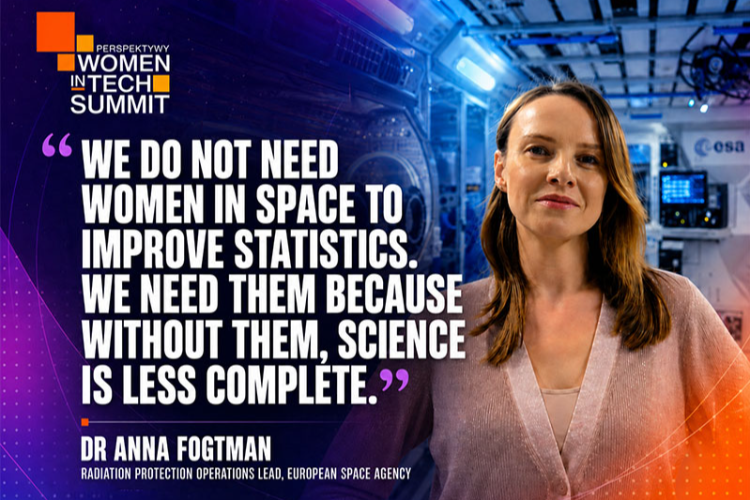
One of the two Polish women working behind the historic Artemis II mission, Dr Anna Fogtman works at the European Space Agency and deals with the impact of ionising radiation on the human body. She once, like almost everyone interested in space, dreamed of seeing the far side of the Moon with her own eyes. She did not become an astronaut, but today she works with astronauts. Anna Rączkowska talks to Dr Anna Fogtman about astronaut selection, space medicine, radiation risk, women in the space sector and why diversity is not a matter of statistics, but of better science and safer missions.
Who did you want to be as a child?
I saw myself in active, agency-driven roles. I was inspired by karate films, superheroes, people who fight evil and save the world. I wanted to be a policewoman, a firefighter. This also pushed me towards sport: I did athletics in the school sports club and in a municipal sports club, I swam, I got up at six on Saturday mornings to go to the swimming pool.
In high school I was convinced that I would become a lawyer, because it turned out that I was good at arguing. But then science drew me in. Sport has stayed with me to this day - maybe I run less, but I walk a lot in the mountains and exercise at the gym. Sport relaxes me.
And when did you dream of becoming an astronaut and flying into space?
I applied to the astronaut selection programme already when I was working at the European Space Agency and saw that it really was possible. I have the impression that many people working in this sector think at least once about flying into space. The selection lasted several months.
What did it consist of? Health and very good physical condition are probably important…
I work in space medicine and, from a medical point of view, physical fitness itself is not as important as is often believed. Health - yes. Fitness - good is enough. You have to be able to swim several lengths of a pool in order to manage if the capsule landed on water. You have to have the strength to run several kilometres. But astronauts also get sick - they are human, after all.
What disqualifies someone?
For example, a limited field of vision. In weightlessness, we perceive space and distances differently, and the spacesuit itself additionally limits the field of vision. Heart diseases are also a problem. Astronauts perform a lot of cardio training during flight and must have the capacity to withstand two hours of demanding exercise a day. A spacewalk, which lasts about eight hours, is also an enormous effort.
Most people are eliminated because of problems with eyesight and the heart. I passed the initial qualification - from about 20,000 people, 1,500 remained, including me. Then eight hours of computer tests awaited me. They tested English, mathematics, physics, but also memory and spatial orientation. They were demanding. Unfortunately, I was eliminated on mathematics, although during preparation it was going well for me. I focused too much on other areas, for example on training memory, because those tasks seemed especially difficult to me.
What qualities are needed to be an astronaut?
Astronauts, regardless of origin, are connected by a very strong belief in themselves and in their abilities. These are people who do not give up. Failure is for them a stage on the way to the goal, not the end of the road. They learn from it and go further.
This is not about arrogant self-confidence, but about a realistic understanding of one’s own abilities and limitations. About accepting that everyone makes mistakes, and about drawing conclusions from them quickly. In space flights, just as in science, failure is part of the learning process.
Introvert or extrovert - does it matter?
There are both. Being an astronaut is, above all, teamwork. People are sought who can cooperate, make decisions, but also acknowledge authority when it is necessary.
In the later stages of selection, candidates take part in group tasks. Some people play specific roles: they apply pressure, provoke, cause discomfort. The point is to check how the candidate reacts under emotional pressure, how he or she responds to ambiguous commands, whether he or she can deal with a moral dilemma.
During a space flight, the most decision-making person is not the astronaut, but the flight director on Earth. It is he or she who sees the whole process, has advisers and makes the final decisions, also medical ones. Protection of life and health is one of the highest priorities, but it may happen that in order to protect the crew, a very difficult decision has to be made.
Girls still apply less often, why?
The biggest barrier is stereotypes and the way of communication. I often argue with my colleagues about whether they would apply for a position if the announcement said: “we are looking for female programmers.” The first stage of equality begins with language and with whether the offer is really communicated to everyone.
If a role does not exist in language, many people will not see a place for themselves in it. This applies especially to girls and young women who are only choosing an educational or professional path.
Then come organisational barriers. If a woman wants to start a family, access to childcare, flexible forms of work, organisational culture and whether household duties are really shared are of enormous importance. In Germany, where I work, many nurseries and kindergartens operate during very limited hours. In practice, such solutions more often push women out of the labour market than men.
This is not solely a matter of individual decisions. It is a matter of a system that makes some choices easier and others more difficult. If scientific and technological institutions want to attract women, they must look not only at recruitment, but also at the conditions for retaining talent in the longer perspective.
At the University of Warsaw, you studied biotechnology.
I did my doctorate at the Polish Academy of Sciences in Warsaw, at the Institute of Biochemistry and Biophysics. Earlier, I belonged to a doctoral college, which unfortunately did not end with a doctoral dissertation. I admit that at that time I lost heart for science for a while.
What happened?
My project was not well organised between two supervisors: one from Poland and the other from Germany. As a result, four years of cooperation with two scientific teams did not bring the expected result and I decided to resign from the college. It was a moment in which I lost faith in my own abilities. It was difficult to cope with that.
I defended my doctorate only later, when a researcher with whom I had previously worked and who was starting her own laboratory persuaded me to do it. She saw potential in me. It was a very important experience: sometimes one person who treats you seriously and sees your competences can change the trajectory of a career.
Today I think that women in science too often use energy not only on the research work itself, but also on proving that they should be at the table at all. This is a cost that is not visible in CVs, publications or grants, but it really affects careers.
How did you find yourself at ESA?
I thought it was a place mainly for engineers, physicists and constructors. But my long-time colleague was already active in space areas and was the first to get into ESA on a contract, although she is a biologist. I began to become interested in the subject, to go to space conferences. It turned out that my competences matched space medicine.
I signed up for the ESA newsletter and began receiving job offers. One of them appeared just before my doctoral defence. It was written in a rather chaotic and crazy way - a bit like my professional experience. I thought: this could be my profile, although the subject itself was not yet exactly mine. I went to the job interview and I was accepted.
What do you do?
I started with a postdoctoral internship, a two-year contract in the space medicine team. I was supposed to develop the concept of a mathematical model for calculating health risk for astronauts.
I also began to cooperate with the European Space Agency team that coordinates scientific research. My task was to connect the world of science and space medicine: so that scientists would know what challenges space medicine is facing, and would propose projects responding to real needs. When my predecessor was retiring, I was offered the position of the lead of the radiation protection operations.
Is the environment in which you work open to women?
The space sector, like many areas of science and technology, was for a long time built mainly by men. This leaves a mark on organisational culture, the way of communication, informal networks of influence and on who is automatically recognised as an expert.
This is not about open hostility being encountered everywhere. More often these are subtle mechanisms: whose voice is more quickly considered credible, who is more often interrupted at meetings, whose ideas are later attributed to someone else, who gets visibility, and who has to repeatedly fight for it.
In Poland, I more often encountered more direct forms of sexism. Abroad, less explicit mechanisms are more often visible, harder to grasp. They are less spectacular, but they can be very burdensome, because they operate for a long time and systemically.
Can you give an example?
Let us imagine an expert meeting. A woman presents an opinion or answers a question because she has knowledge in a given area. The reaction is weak or there is none. After a moment, someone else repeats the same thought and only then is it treated as important. This is a known mechanism in many professional environments, not only in the space sector.
That is why allies are so important. If at a meeting someone repeats someone else’s thought, one can say: “It is good that we are returning to the point Kate raised a moment ago.” It is a small intervention, but it restores authorship and visibility.
Can such things be reported? Are there procedures? HR?
There are anti-mobbing and anti-discrimination procedures. They are needed, but they do not always cope well with what is soft, dispersed and repetitive. Mansplaining, being omitted in discussion, taking over ideas, exclusion from the informal circulation of information - these are phenomena that are difficult to capture in one complaint.
That is why what is needed is not only procedures, but also organisational culture: clear rules for running meetings, transparent criteria for promotion, conscious leadership and reacting to small patterns before they become the norm.
And maybe this is simply competition in a very ambitious environment?
Competition, of course, exists. Science and the space sector are very demanding. But research on organisations shows that competition does not work the same way for everyone. Self-confidence is read differently in men and differently in women. Ambition, assertiveness or readiness to speak up are interpreted differently.
The problem is not individual people, but repetitive patterns: who is more often listened to, who more often receives trust, who has to prove competences from the beginning with every new project. These are mechanisms that can weaken diversity in science and technology.
I always wonder whether it is nature or culture.
In my opinion, above all culture. Of course, we are biological organisms, we are governed by hormones and physiology, but we also have brains, institutions, education, social norms. We fly to the Moon, so we really can also learn equal treatment of people in the workplace.
Why is it important that women work at ESA? What impact does it have on achievements, inventions, ideas?
A monocultural and single-sex environment does not see the full spectrum of problems. If we want to send people into space, we must understand different bodies, different needs and different experiences.
This is very practical. Spacesuits have to be designed to fit different silhouettes. Hygiene systems and toilets have to be designed so that they work for women and men. Menstruation, anatomical differences, physiological differences, as well as how different organisms react to isolation, radiation or microgravity, have to be taken into account.
This is not about political correctness. It is about the quality of science, mission safety and good design. If there is no diversity in the team, some problems will be noticed too late.
And if someone says: let women not fly, if it complicates design?
That would be an absurd conclusion. The goal of space exploration is not the comfort of designers, but the development of knowledge and technology for humanity. Women are half of humanity. If public money, also from women’s pockets, finances space research and technologies, then these technologies must take everyone into account.
You deal with the impact of cosmic ionising radiation on the human body. At one time, on the basis of limited data, it was considered that it may act worse on women than on men. Could this have been used as an argument against women in space?
At one point NASA asked the American National Academy of Sciences to evaluate such an approach. The conclusion was that there was too little data to limit women’s possibility of taking part in space missions on that basis.
Ionising radiation may increase the risk of cancer, but this is not the only possible effect. We also study its impact on the cardiovascular system, the central nervous system, cognitive functions or mental health. Some studies suggest that in selected aspects men may be more susceptible to certain neurological effects. This shows how dangerous simple conclusions based on incomplete data are.
In space medicine, the point is not to create arguments excluding any group. The point is to understand risk and manage it in the most precise way possible.
What other threats result from radiation?
Cosmic radiation is diverse, comes from different sources and we are exposed to it throughout the entire duration of the mission. Different types of particles and energies interact with tissues in different ways. We are not able to protect ourselves from it completely, which is why we talk rather about managing risk than eliminating it.
We limit exposure through shielding, planning the flight trajectory, monitoring doses and limiting the time spent in outer space. But the consequences may appear many years after returning to Earth. They may also not appear at all. All of this is probabilistic.
What can happen?
A lot depends on individual predispositions, although astronauts usually represent the healthier part of the population. We do not routinely perform genetic tests, but very detailed clinical screening allows us to identify people who are particularly at risk.
Ionising radiation can damage tissues, including heart tissue or brain tissue. It may affect memory, spatial orientation, cognitive functions and mental health. Effects concerning the central nervous system are among the least understood, and at the same time they worry us very much. During a mission, one may have a physiologically healthy person, but if cognitive disorders appear, this may endanger the entire crew.
The problem is the small amount of data. Relatively few people have been in space so far. The longest missions lasted more than a year, but there are too few such cases to draw strong epidemiological conclusions. Many astronauts are still alive, so we do not yet know all possible long-term consequences. In addition, other factors overlap with the results: microgravity, isolation, stress, sleep disorders, intensive training.
So many unknowns, and yet so many people want to fly into space.
The risk is great, but please imagine that you are one of the few people on Earth who can see the far side of the Moon. Or that you can see something that no one has seen before, and it will change the way of thinking about some scientific problem.
For many people, especially scientists, this experience is worth the risk. Space is one of the most demanding environments we know, but precisely because of that it teaches us so much - about technology, biology, medicine and ourselves.
What would you say to girls and women who are interested in space, but do not see a place for themselves there?
That they should not assume in advance that the space sector is only for rocket engineers. Biologists, doctors, psychologists, data specialists, designers, lawyers, communication experts, people from project management, materials science, robotics, artificial intelligence, environmental protection are needed.
Space is interdisciplinary. If someone has curiosity, competences and readiness to learn, they can find a place in it. Girls often wait until they meet all the requirements from the job announcement. It is not worth waiting. One has to apply, try, look for mentors and environments that treat competences seriously.
We do not need women in space in order to improve statistics. We need them because without them science is less complete.
Interview by Anna Rączkowska