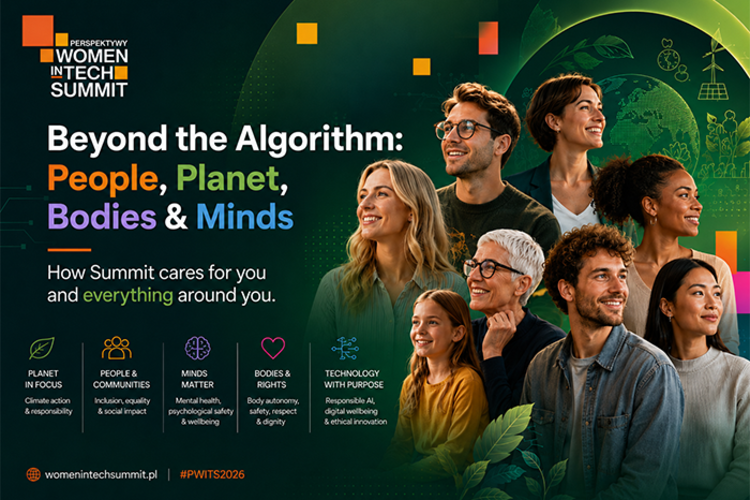
Technology is often described through acceleration: faster systems, smarter algorithms, more powerful AI, deeper science, stronger infrastructure and bigger breakthroughs. But speed alone does not define progress. The deeper question is: what kind of future are we building and who is included, protected and strengthened by it?
For nearly twenty years, Perspektywy Education Foundation has supported girls and women in STEM through scholarship, mentoring and educational programmes. The Foundation’s mission has been about changing the culture of education, science and technology so that talent is not filtered out by gender, background, stereotype, identity, neurotype, mental health, social pressure or lack of access. As Perspektywy’s recent reflection on STEM education states, wise support for women in STEM has never been a war against boys or men; it is a long-term cultural shift toward cooperation, respect, shared responsibility and a broader understanding of diversity.
Across seven editions, Perspektywy Women in Tech Summit has grown into one of Europe’s largest meeting points for women in technology, science, engineering and innovation. But it has also become something more: a large-scale proof that technology can be discussed, designed and experienced with human responsibility at the centre.
At the Summit, “human-centred technology” is visible in climate reporting and nature restoration, in LGBTQ+ advocacy and neurodiversity infrastructure. It is visible in conversations about harassment, cyberviolence, psychological safety, mental health, digital overload, body autonomy, pleasure, human endurance, inclusive AI and the right to simply belong.
Because the future of technology will not be judged only by what we managed to build. It will also be judged by who was safe enough to build it, who was seen, who was protected, who was invited in - and whether the planet could survive our idea of progress.
For the planet: climate responsibility backed by data
Perspektywy Women in Tech Summit has been calculating and publishing its full event carbon footprint since 2022, in partnership with Plan Be Eco and using GHG Protocol methodology. The reports cover direct and indirect emissions across scopes, including participant travel, accommodation, energy, catering and materials. In 2025, despite reaching 14,000 participants, the Summit reported 35 kg CO₂e per participant and a total footprint of 453 t CO₂e, with total emissions down by 19% compared with 2024.
The Summit’s environmental strategy is concrete: public transport, bike infrastructure, plant-based catering, Warsaw tap water, digital-first materials, lower-waste solutions and a hybrid model that allows thousands of participants to join without travelling. In 2025, the full 453 t CO₂e footprint was offset through the restoration of 260 hectares of degraded wetlands in eastern Poland (Krychów–Krowie Bagno, Holeszów and Kamień) together with Amazon Web Services and OTOP BirdLife Poland.
Perspektywy’s climate-positive approach has been built over several years. In 2022, the Foundation created a perpetual forest in the buffer zone of Biebrza National Park with Orange Polska. In 2023, it supported a biodiverse forest in Podlasie. In 2024, with AWS and OTOP, Perspektywy joined a wetland reclamation project covering approximately 260 hectares and estimated to reduce greenhouse gas emissions by more than 20,249 tCO₂e.
The climate commitment has also been part of the Summit programme. The Climate Positive Zone has included talks and workshops on peatland restoration, AI’s environmental costs, carbon footprint accounting, personal carbon footprint tracking, green careers, biodiversity, climate resilience through geospatial technology, climate communication, aquatic warbler protection, urban botanical sexism and technology for a healthier future.
For society: education, visibility and the right to be remembered
Technology with humanity also means asking who has been left out of science culture — and correcting that absence. One of the strongest symbolic examples is the story of Maria Skłodowska-Curie at CERN - since November 2025, the full name of Maria Skłodowska-Curie has been restored on the CERN campus, in CERN’s systems and in the Geneva canton. This is not only a story about a street sign. It is a story about how science remembers women: their names, identities, histories and achievements.
This social mission continues this year at the Perspektywy Education Foundation Zone: it is a space for inspiration, support and community: participants can learn about Foundation initiatives supporting women in tech, talk to an AI avatar, receive personal career advice from female tech experts in the IT for SHE zone, meet alumnae, discover inspiring career stories, record their own story, join fast-paced tech workshops, take part in a quiz about women in science and technology, and connect with communities supporting women in technology all year round.
For equality: LGBTQ+ visibility, inclusive AI and the right to show up fully
Perspektywy Women in Tech was honoured with the Crown of Equality 2024 in the Business category by Campaign Against Homophobia for its commitment to equality, diversity and inclusion in technology, business and the workplace. The recognition was connected with the Summit and the accompanying Future of Tech is Queer initiative.
The LGBTQ+ work at the Summit has included panel discussions, Living Libraries, workplace stories, networking, advocacy for marriage equality and a rainbow parade through Expo XXI. The initiative has highlighted the role of LGBTQ+ people in shaping technology and inclusive workplaces, with personal stories of courage, resilience and authenticity.
This year, the work continues through The Future of Tech is Queer. The 2026 session explores inclusion through the lens of today’s social realities and rapidly evolving technology. It opens with a keynote by Julia Maciocha on visibility, representation, social and cultural shifts, human energy, engagement and the barriers that prevent people from fully showing up as themselves. It then moves into a panel on Responsible AI and unconscious bias, asking how technology can reinforce inequalities - and how fairer, more inclusive systems can be built.
For neurodivergent people: inclusion as real infrastructure
Inclusion is not real if people have to survive environments that overwhelm them. That is why the Summit has developed dedicated neurodiversity spaces.
In 2024, Perspektywy Women in Tech Summit introduced Neurodiversity Harbor - a quiet environment designed to support neurodivergent people and anyone overwhelmed by crowds, noise and intensity. It offered space for rest, lectures, discussion panels and small moderated circles where participants could safely share experiences of neurodiversity.
In 2026, the Neurodiversity Zone continues this approach. Located in the Onyx Room and created in partnership with NatWest, it is a calm, quiet and safe space for people feeling tired, overwhelmed or in need of a break from the sensory intensity of a large conference. The zone is designed for recharging, reducing stress, reflection, learning, expert consultations, group conversations and mindful inclusion. Its central message is clear: real inclusion begins where people feel safe enough to simply be.
The Summit also includes Overlooked Friends and Foes: Neurodivergent Traits in Women Leadership, a workshop on how traditional leadership models still reward linear careers, constant availability, high sensory tolerance, fast decision-making, public confidence and forms of assertiveness associated with neurotypical and male-coded leadership styles. It asks what these models cost neurodivergent women leaders — and how they can build leadership models based on their strengths.
For bodies, pleasure, health and safety
This year’s Summit opens conversations that technology conferences often avoid: bodies, pleasure, harassment, intimate partner violence, mental health, stress, human limits and the physical consequences of technological acceleration.
Let’s make masturbation great again is a special event with Aga Kozak that asks direct questions about masturbation: myths and truths, scientific research, misconceptions, unconscious beliefs, the usefulness of “the M word”, the way we perceive life and ourselves, and our relationship with body and pleasure.
How to Respond to Harassment Safely and Creatively - practical training teaches participants how to react when they experience harassment, how to help as bystanders, and how to take care of safety and resilience. The training introduces the 5D Method: Distract, Delegate, Document, Direct and Delay support. It also points to the scale of the problem: up to 77% of women in Poland have experienced harassment in public spaces, while only one in two people say they would intervene when witnessing harassment. The training is delivered by Feminoteka as part of the Stand Up Against Street Harassment campaign, in cooperation with L’Oréal Paris and Right To Be.
Kiedy technologia krzywdzi - cyberprzemoc w relacjach partnerskich addresses digital stalking, deepfakes, account takeover, location-tracking apps and other forms of tech-enabled abuse in intimate relationships. The workshop covers perpetrator mechanisms, psychological consequences for victims and practical protection methods, including multi-factor authentication and detecting unknown tracking apps. It also discusses AI-enabled threats such as face and voice swapping, nudifier tools and manipulated images or audio used for blackmail and harassment.
The Rewritten Body: Medicine, AI, and the End of Natural? Biotech in the Age of Breakthrough looks at the technology-driven transformation of medicine: CRISPR-based therapy, computational biology, AlphaFold 3, personalised mRNA cancer vaccines, bioprocess engineering, medtech and AI-to-clinic translation. It asks what “natural” means when biology becomes increasingly computable - and what Europe must do to help build, rather than merely import, the future of healthcare.
Multimodal Digital Phenotyping of Human Health Across the Lifespan asks how we can understand health not only in the doctor’s office, but also in everyday life. Daria Hemmerling will show how data from wearable devices, immersive environments and speech analysis can capture subtle signals from the human body.
For mental health, stress and psychological safety
A human Summit must also talk about pressure: the pressure to perform, to be available, to be resilient, to be happy, to lead, to adapt and to stay productive even when systems accelerate faster than people can.
Stres jako interpretacja otaczającej nas rzeczywistości - Jak utrzymać równowagę w wymagającym środowisku zawodowym introduces participants to the psychological and biological mechanisms of stress. It shows how alarm reactions in the body affect emotions, concentration and workplace behaviour, and teaches practical techniques for reducing tension, recognising warning signs and building long-term psychological resilience.
Safe Means Brave. Psychological safety isn’t “nice” - it’s the courage to say the hard thing treats psychological safety as a skill rooted in courage, not comfort. The workshop explores biological foundations of safety, including how the brain and nervous system respond to threat and trust, and translates the concept into speaking up, learning, collaboration, self-reflection and concrete team practices.
Wired for Wellbeing: How Technology Can Personalize and Transform Mental Health Care focuses on the growing challenges of mental health and wellbeing: limited access, shortage of professionals, rising costs, stigma and scepticism toward new forms of support. It presents digital mental health as a way to expand access, support evidence-based interventions and use real-world data from smartphones, smartwatches and wearables to personalise care and enhance therapy.
For digital wellbeing and cognitive sovereignty
The Summit also asks what happens to human attention when AI and digital systems become faster, cheaper and more persuasive than ever.
Cyfrowy minimalizm w dobie AI - czyli jak nie zwariować korzystając ze sztucznej inteligencji? identifies the paradox of abundance: AI promises to reduce workload, but often multiplies tools, subscriptions and “must-have” workflows. Artur Kurasiński’s talk distinguishes outsourcing mechanical tasks from outsourcing thinking, highlights attention hygiene in the era of infinite personalisation, warns against “default yes” adoption of every AI feature, and frames cognitive sovereignty as a new form of freedom.
Less Feed, More Life: The Case for Digital Minimalism explores how endless notifications, screen fatigue and technology overload reshape how we work, connect and rest. The panel brings together professionals, Gen Z and organisations challenging the always-on culture, from dumb phones to app-free mornings, boundary-setting and intentional technology use that can help reclaim focus, mental clarity and time.
Ghost in the Machine: Exorcising Your Digital Waste Graveyard connects digital overload with sustainability. Participants confront the invisible carbon impact of abandoned files, forgotten folders and old digital clutter, and explore virtual minimalism as a way to declutter both digital life and environmental footprint.
For responsible AI, fairness and social sustainability
A more human technology culture also needs to ask hard questions about fairness.
The AI Impact Lab: when “fair” isn’t simple and “sustainable” isn’t optional is an interactive workshop where participants become an AI Advisory Board and make decisions about designing, deploying and fixing AI systems in high-stakes scenarios such as hiring, healthcare, finance, education and sustainability ratings. A simulation app tracks team decisions across two axes — Fairness and Social Sustainability — exposing trade-offs participants may not have seen coming.
Quantum Diplomacy Game expands this responsibility into science diplomacy. The immersive role-play game places participants in a fictional geopolitical crisis triggered by a breakthrough in quantum computing, asking them to negotiate, collaborate and anticipate how today’s decisions could prevent tomorrow’s conflicts. The game was originally developed at GESDA for the Open Quantum Institute, hosted by CERN, and promotes global, inclusive access to quantum computing and applications for the benefit of humanity.
At Perspektywy Women in Tech Summit, technology is not treated as an abstract force moving forward on its own. It is created by people, shaped by culture, powered by resources, felt in bodies and communities, and measured against the limits of the planet.
That is why the Summit connects innovation with climate responsibility, science with equality, AI with mental health, cybersecurity with intimate partner violence prevention, leadership with psychological safety, biotech with the future of the body, digital minimalism with cognitive sovereignty, and inclusion with actual infrastructure: quiet rooms, safe spaces, education zones, community support and measurable environmental commitments.
The future of technology needs more than algorithms. It needs people who can breathe, think, belong, disagree, recover, protect one another, design fairly, remember the erased, care for the planet and build systems that make life more human - not less.